Teresa Overcash, a 30-year top 1 percent NC agent, Broker/Owner of Realty ONE Group Results, and NCREC Licensed Instructor, has walked buyers through their first Banner Elk offer, their first Sugar Mountain closing, and their first surprise vacation rental tax bill. This is the conversation she has with every High Country second home buyer before they write an offer.
Jump to a section:
Festival weekend at a glance
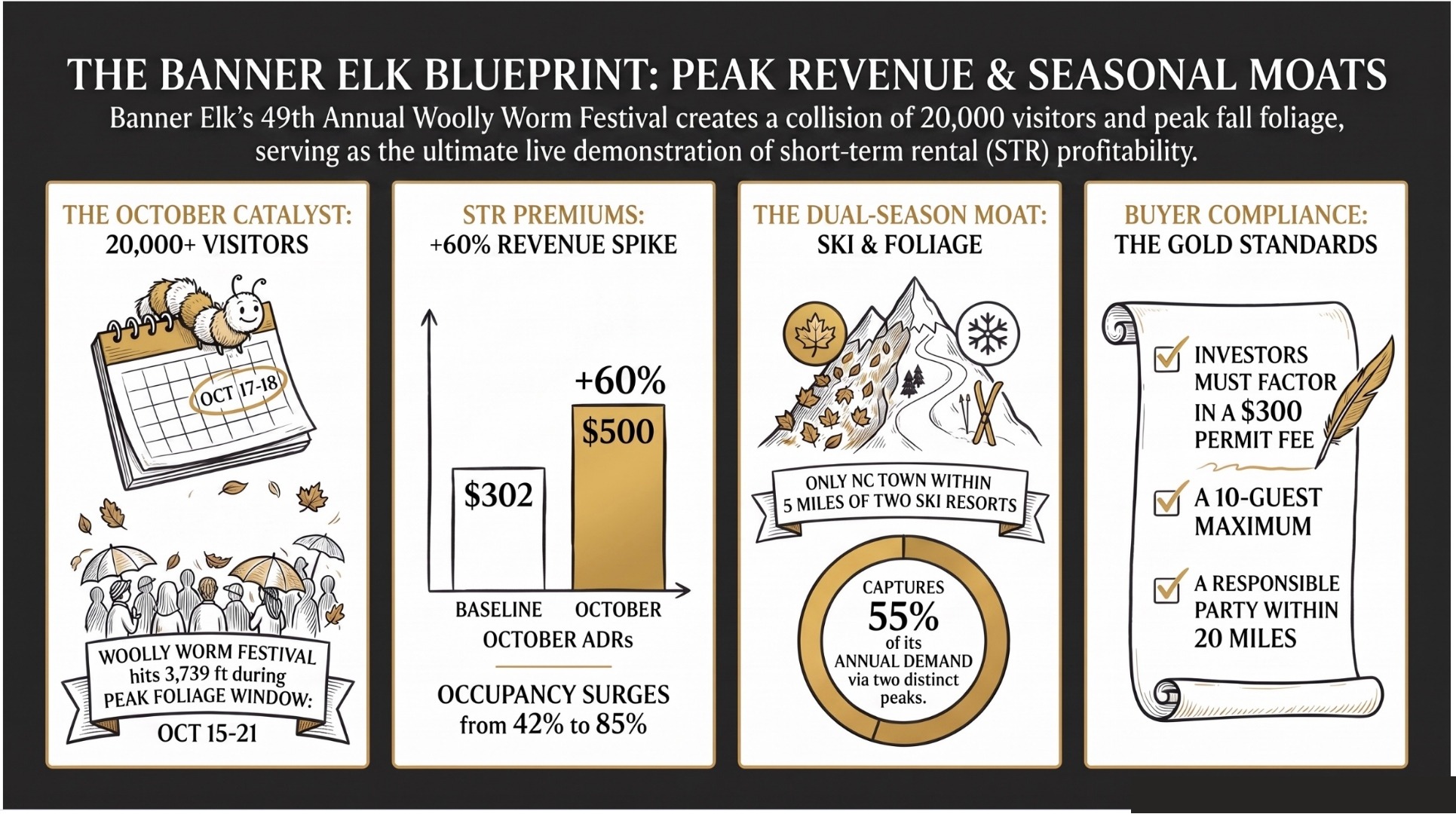
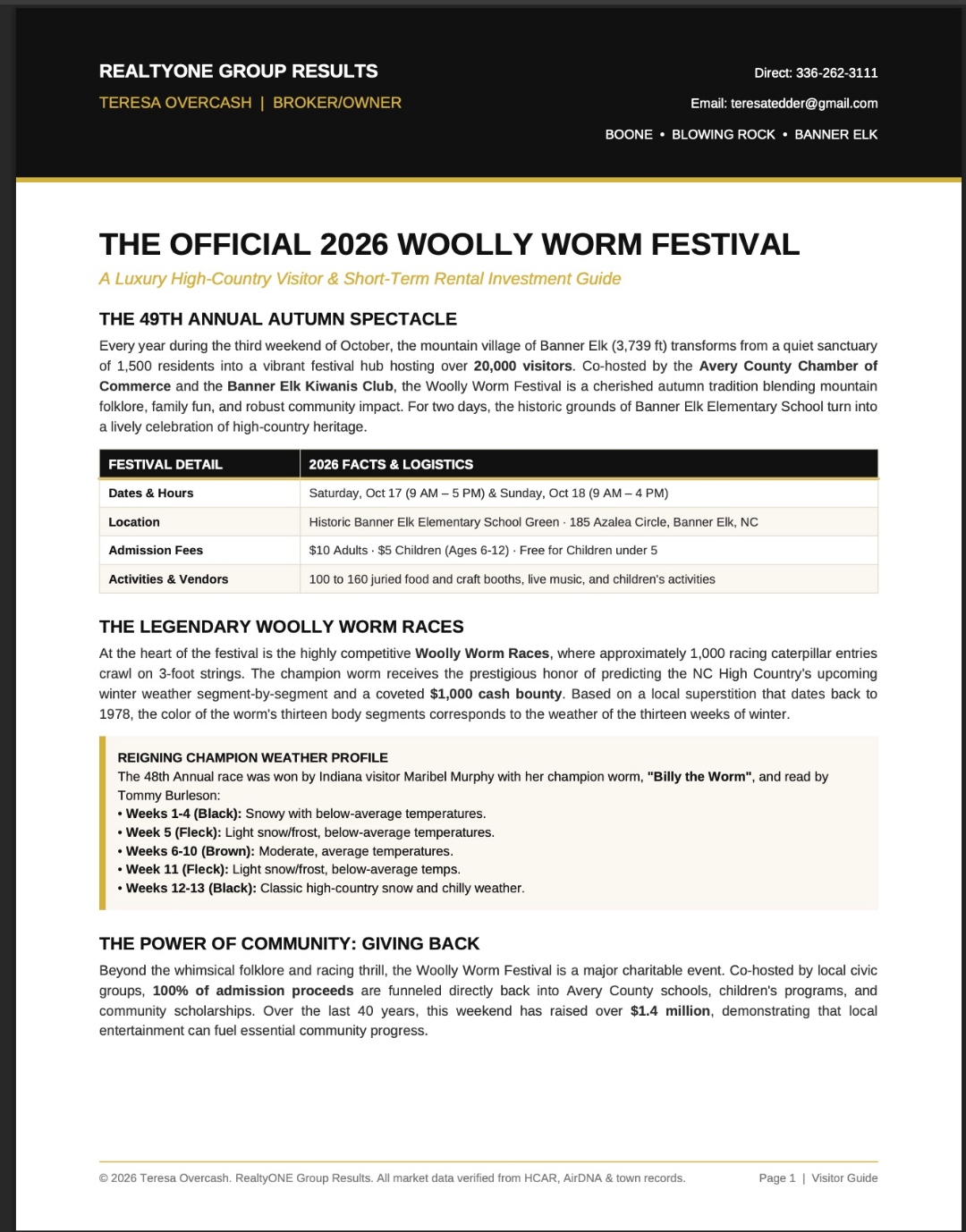
The Woolly Worm Festival started in 1978 with a Banner Elk local named Jim Morton and a blade of grass. Nearly 50 years later, the third weekend of October in Banner Elk means 20,000 people, 100 to 160 vendors, 1,000 racing caterpillars, and one very serious winter weather forecast delivered by whichever worm climbs a string first. The Avery County Chamber of Commerce and the Banner Elk Kiwanis Club co-host the event on the grounds of the historic Banner Elk Elementary School at 185 Azalea Circle, and every dollar of admission goes back to Avery County youth programs. Over 40 years the festival has raised more than $1.4 million for local children (Atlas Obscura, WLOS).
What that means for the person considering a Banner Elk second home purchase: for two days in October, the town of 1,500 becomes a town of 21,500. Nightly rental rates spike. Restaurants book out. Traffic on Highway 184 slows to a walk. And every property owner in a five-mile radius of downtown Banner Elk collects a real market signal about what their home can actually earn in the peak two weeks of the year.
Table 1 — Woolly Worm Festival 2026 at a glance
| Detail | 2026 fact |
|---|---|
| Dates | Saturday, October 17 – Sunday, October 18, 2026 |
| Edition | 49th Annual |
| Venue | Historic Banner Elk Elementary School Green · 185 Azalea Circle |
| Expected attendance | 20,000+ visitors across two days |
| Vendors | 100 to 160 craft, food, and local business booths |
| Worm races | ~1,000 caterpillar entries; winner forecasts NC High Country winter |
| Admission | $10 adult · $5 ages 6-12 · free under 5 |
| Co-hosts | Avery County Chamber of Commerce · Banner Elk Kiwanis Club |
| State designation | Official North Carolina Woolly Worm Festival (2018) |
| Charitable total | $1.4 million raised for Avery County youth programs over 40 years |
Sources: Woolly Worm Festival official; Town of Banner Elk; Blue Ridge Heritage; WLOS.
Banner Elk short-term rental rates during Woolly Worm weekend
Here is where the festival stops being a fall festival and starts being a market indicator. AirDNA pegs the Banner Elk market at 3,204 active listings as of July 2026, down 13.2 percent year over year as supply consolidates. The trailing twelve-month average daily rate sits at $342, up 10.6 percent, with an average annual revenue per property of $26,800 and market-wide occupancy of 42 percent (Epic Agents Podcast, AirDNA July 2026 data). AirDNA scores Banner Elk 83 out of 100 overall, with an investability subscore of 85. Those are strong numbers for a market of this size.
The October story is the interesting one. According to the Crest Cove 2026 Banner Elk market report, mid-tier properties charge $420 to $500 per night in October, a 40 to 60 percent premium over the annual baseline. Occupancy jumps into the 70 to 85 percent range. Fall foliage season alone accounts for 15 to 20 percent of annual Banner Elk STR demand, compressed into roughly three weekends (Crest Cove 2026 Banner Elk report).
I have shown Banner Elk homes on Woolly Worm weekend more times than I can count. It is the only weekend of the year when a buyer can walk out of a showing, look at the traffic on 184, watch the parking lots overflow, and see the exact rental income the listing agent is quoting them. You cannot fake that market energy. You either believe your numbers or you do not.
Teresa Overcash, Broker/Owner Realty ONE Group Results, on Banner Elk buyer showings
Table 2 — Banner Elk STR October pricing vs annual baseline
| Metric | Annual baseline | October peak | Premium |
|---|---|---|---|
| Mid-tier property ADR | $302 / night | $420–$500 | +40 to 60% |
| Non-peak October rate | $302 / night | $360–$390 | +20 to 30% |
| Occupancy | 42% | 70–85% | +30 to 45 pts |
| Foliage-positioned property | $302 / night | $420–$700+ | +40 to 130% |
| Sugar Mountain within 2 miles | $342 avg | $350–$500 | +15 to 25% base premium |
| Peak-color revenue window | — | ~10 days | 3–5% of annual revenue |
Sources: Crest Cove 2026 Banner Elk STR market report; Epic Agents Podcast, AirDNA July 2026 data.
Fall foliage timing is elevation math
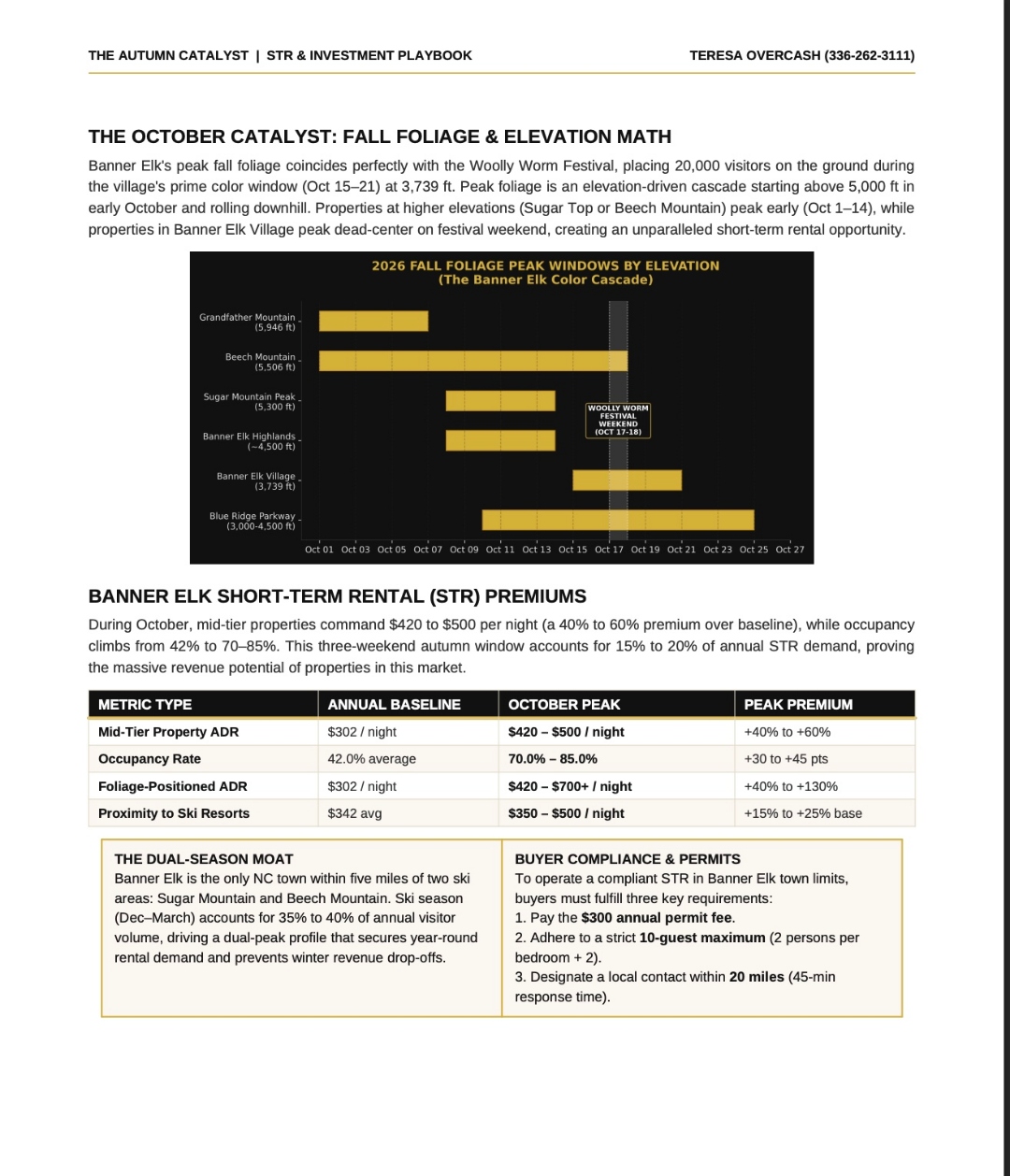
The reason Woolly Worm weekend hits so hard is not the caterpillars. It is that the calendar puts 20,000 visitors on the ground during the exact seven-day window when Banner Elk village turns gold and red. Fall color in the High Country is not a single weekend. It is an elevation-driven cascade that begins the first week of October above 5,000 feet and rolls downhill for three weeks (see the full 2026 High Country foliage guide).
Here is why that matters for your buyer decision. If you buy a property above 4,500 feet — think Sugar Top, Beech Mountain, or the higher lots off Skyline Drive — your peak color hits October 1 through 14. Woolly Worm weekend on October 17-18 is on the tail end of your window. If you buy in the village or on the lower slopes at 3,700 to 4,000 feet, Woolly Worm weekend is dead center on your peak. Your two-week rental income cycle is completely different depending on which elevation you close on.
Table 3 — Fall foliage peak windows by elevation, 2026
| Location | Elevation | Peak color window | Overlap with Woolly Worm Oct 17-18 |
|---|---|---|---|
| Grandfather Mountain | 5,946 ft | Oct 1–7 | Past peak; still colorful |
| Beech Mountain | 5,506 ft | Oct 1–18 | Tail end of peak |
| Sugar Mountain peak | 5,300 ft | Oct 8–14 | Just past peak |
| Banner Elk highlands | ~4,500 ft | Oct 8–14 | Just past peak |
| Banner Elk village | 3,739 ft | Oct 15–21 | Dead center of peak |
| Blue Ridge Parkway mid-elevations | 3,000–4,500 ft | Oct 10–25 | Peak weekend |
Sources: Homes in Triad NC Fall Foliage 2026 guide; Blue Ridge Parkway Foundation; Grandfather Mountain.
Avery County market data: what your buying dollar is competing for
Avery County is a small market. In an average month, 30 to 50 residential properties close across the entire county. That small sample means monthly medians can swing hard. June 2026 closed 32 residential sales at a median of $616,750 in Avery, up 32.6 percent from May. July closed 47 sales at a median of $484,000, down 21.5 percent from June (Watauga Democrat and HCAR, HCAR Market Data Reports). That is not a market collapse. That is a small county absorbing a change in what the 30 to 50 closings that month happened to be. Anyone quoting you a single monthly Avery median is missing half the picture.
Zooming in on Banner Elk town: Zillow reports a home value index around $584,000, Redfin reports a median sale price of $625,000 and a year over year gain of 14.2 percent, and the median list price runs $877,000 to $954,000. Days on market average 143, and typical closing price runs about 3 percent under asking (Epic Agents Podcast). Realtor.com pegs Banner Elk town median list at $329,000 with 382 homes for sale and 95 days on market, reflecting the wider land-and-condo inventory (Realtor.com Avery County).
What that spread tells you as a buyer: Banner Elk is not one market. It is at least four. Full-time-resident modest homes in the $300s. Weekend and second homes in the $500s to $700s. Golf-community homes on Elk River and Hound Ears in the $900s to $2M. Ski-in and ski-out condos in a range of their own. Whatever your comfort level, there is a Banner Elk lane for it. But the Woolly Worm weekend income math changes lane by lane.
Table 4 — High Country Association of Realtors, Avery County residential 2026
| Month | Avery closed sales | Avery median | Four-county combined median |
|---|---|---|---|
| January 2026 | 22 | $440,000 | $502,500 |
| April 2026 | 30 | $560,000 | $512,500 |
| May 2026 | — | — | $482,500 |
| June 2026 (peak) | 32 | $616,750 | $520,000 |
| July 2026 | 47 | $484,000 | $470,000 |
Sources: High Country Association of Realtors monthly market data; Watauga Democrat HCAR June 2026 report.
Small counties like Avery move by property type, not by month. Do not let a monthly median swing spook you off a house you love or push you into one you do not. Match the property to your use case, verify the STR permit and revenue with the town, and let the seasonal calendar carry the income math. That is how you buy a Banner Elk home you keep for the long haul.
Teresa Overcash, Broker/Owner Realty ONE Group Results, on Avery County market timing
The ski season follow-on that Woolly Worm hides
Foliage is only half the Banner Elk story. Roughly six weeks after the last woolly worm crosses the finish line, Sugar Mountain fires up its snow guns. The 2025-26 Sugar Mountain season ran November 11, 2025 through March 26, 2026 across 129 skier days and 69.5 inches of natural snowfall (Sugar Mountain Stats). Season passes for 2026-27 are on sale now at $794 through June 30 and $1,312 at regular pricing (Sugar Mountain Passes). Beech Mountain, at 5,506 feet the highest ski area east of the Mississippi, layers a second product on top.
Banner Elk is the only town in North Carolina within five miles of two ski areas. That single geographic fact is the reason Banner Elk STR revenue does not collapse the way Blue Ridge Parkway-only markets do after the leaves come down. Ski season December through March represents 35 to 40 percent of annual visitor volume, layered on top of the fall foliage 15 to 20 percent. Summer, spring shoulder, and the festival week fill in the rest. That is a dual-peak revenue profile most southern Appalachian STR markets simply do not have.
What Woolly Worm weekend does for the ski-season underwriter is give you a live look at how well the town moves 20,000 people. If parking works. If Highway 184 recovers. If restaurants staffed correctly. Those same operational muscles carry Christmas week, Presidents Day weekend, and every powder day between them. If Banner Elk cannot move 20,000 visitors well in October, it cannot move them well in January either. It moves them well.
The buyer math for Woolly Worm weekend
Here is the shortcut you can use as a Banner Elk buyer. Take your target purchase price. Assume an $342 average daily rate at 42 percent baseline occupancy for the year. That gives you roughly $52,000 of gross annual revenue at market average. Now apply the October peak: two weekends of $450 nightly rate at 80 percent occupancy adds another $2,500 of concentrated fall revenue you can lean on. That two-weekend spike is the difference between a Banner Elk property that carries itself and one that costs you money.
You want the property positioned to capture both catalysts: within 20 minutes of the festival grounds, within a five-mile drive of a Sugar or Beech lift, and with a photograph-ready view or hot tub. The listings that check all three run 20 to 35 percent above baseline year-round according to Crest Cove, with an additional 40 to 60 percent lift during peak color. That premium is not automatic. It is the reward for buying the right property in the right zip code and marketing it the right way.
The buyers who win in Banner Elk are the ones who tour on Woolly Worm weekend. You see the peak. You feel the traffic. You watch the parking. You meet the neighbors who bought two years ago and are already booked out for October 2027. Nothing on a spreadsheet moves you the way that weekend does. That is why I bring buyers up for it.
Teresa Overcash, Broker/Owner Realty ONE Group Results, on Banner Elk tour timing
Five questions to ask before you buy for the festival market
- Where is the STR permit? Banner Elk requires a $300 town permit, 10-guest maximum, and a responsible party within 20 miles who can respond within 45 minutes. Confirm the seller has one in good standing, and confirm the ordinance did not change since it was issued.
- What is the distance to festival grounds? Under 3 miles is walkable-adjacent premium. 3 to 10 miles is drive-in convenience. Over 10 miles and you are competing on price with Boone and Blowing Rock instead of Banner Elk.
- What is the elevation and foliage window? The village at 3,739 feet peaks the exact festival weekend. Higher elevations peak a week or two earlier. Match your rental positioning to the peak.
- What is the two-week gross revenue history? Ask the seller or listing agent for the two-week gross for the October 8 through 22 window across the last three years. That number carries more weight than any annual average.
- What is the winter access? Woolly Worm hides winter operations. Confirm state road plow priority to the driveway, driveway grade, and driveway exposure before you write.
Banner Elk Woolly Worm Weekend 2026 briefing
The full buyer briefing in one PDF — festival details, foliage-by-elevation timing, Avery County STR permit rules, and the five questions every Banner Elk buyer should ask before writing an offer.
Frequently asked questions
When is the Woolly Worm Festival in 2026?
The 49th Annual Woolly Worm Festival runs Saturday and Sunday, October 17-18, 2026, on the grounds of the Historic Banner Elk Elementary School at 185 Azalea Circle. The festival is co-hosted by the Avery County Chamber of Commerce and the Banner Elk Kiwanis Club and draws more than 20,000 visitors across the two days.
Why does the Woolly Worm Festival matter to Banner Elk real estate?
The festival lands on the same weekend Banner Elk village hits peak fall foliage color, roughly October 15-21. That stacking creates the single highest short-term rental revenue weekend on the Banner Elk calendar. Crest Cove reports mid-tier October nightly rates of 420 to 500 dollars, a 40 to 60 percent premium over baseline, with October occupancy in the 70 to 85 percent range. For second home buyers considering a Banner Elk purchase, the festival weekend is the clearest live demonstration of the property income potential you are underwriting.
What are Banner Elk short-term rental rates during Woolly Worm weekend?
AirDNA July 2026 data pegs the Banner Elk market at an average daily rate of 342 dollars trailing twelve months, up 10.6 percent year over year. October rates run 40 to 60 percent above that baseline for mid-tier properties, according to the Crest Cove 2026 Banner Elk market report. Foliage-positioned properties near Sugar Mountain and Elk River Club can command an additional 20 to 35 percent premium during the peak color window.
What is the Banner Elk median home price in 2026?
The High Country Association of Realtors reported an Avery County median sales price of 616,750 dollars for June 2026 on 32 closed residential sales, up 32.6 percent from May. July 2026 pulled the median down to 484,000 dollars on 47 closed sales as inventory expanded. The wider four-county High Country median for June was 520,000 dollars. Banner Elk town-level values run higher, with Zillow near 584,000 and Redfin reporting a median sale price of 625,000 with a 14.2 percent year over year gain.
When does fall foliage peak near Banner Elk?
Peak color in the NC High Country runs October 10 through October 25, 2026, driven by elevation. Above 5,000 feet, color begins the first week of October, so Grandfather Mountain at 5,946 feet and Beech Mountain at 5,506 feet peak first. Sugar Mountain and the Banner Elk highlands peak October 8 through 14. Banner Elk village at 3,739 feet peaks October 15 through 21, placing Woolly Worm weekend squarely inside the village peak window.
Is Banner Elk a good market for a short-term rental second home?
AirDNA gives Banner Elk a Market Score of 83 out of 100 as of July 2026, with an investability subscore of 85 and a revenue growth subscore of 82. The market carries 3,204 active listings, down 13.2 percent year over year as supply consolidates, with average annual revenue of 26,800 dollars per property. Banner Elk is the only town in North Carolina within five miles of two ski areas, which drives a dual-season revenue pattern that most southern Appalachian STR markets do not have.
What does Banner Elk require for a short-term rental permit in 2026?
The Town of Banner Elk requires a 300 dollar permit fee, a maximum of 10 guests per property, an occupancy limit of two persons per bedroom plus two, and a responsible party who lives within 20 miles and can respond within 45 minutes. Verify current rules with the Town of Banner Elk before you write an offer, because the ordinance is actively being refined.
When does Sugar Mountain open for the 2026-27 ski season?
Sugar Mountain Resort has historically opened between early and mid-November, with the 2025-26 season running November 11, 2025 through March 26, 2026 across 129 skier days and 69.5 inches of natural snowfall. Season passes for 2026-27 are on sale now, priced at 794 dollars before the June 30 early-bird deadline and 1,312 dollars at regular season pricing. Ski season traffic layered onto foliage-season traffic is why Banner Elk carries a dual-peak STR revenue pattern.
Ready to tour Banner Elk on Woolly Worm weekend and see the market at peak?
The third weekend of October is the smartest weekend of the year to look at a Banner Elk second home. You see the town at full occupancy. You watch the STR income cycle live. You meet the neighbors who bought two years ago and never regretted it. Get the pre-showing briefing before you write.
Call or text: 336-262-3111
Email: teresatedder@gmail.com
Teresa Overcash, Broker/Owner, Realty ONE Group Results. 30 years in North Carolina real estate. 10,000+ NC closings. Serving the Triad, Wilkes County, and the NC High Country with access to 4 MLS systems and a national network of 22,000+ agents.
About the author. Teresa Overcash is Broker in Charge and Owner of Realty ONE Group Results, an NCREC Licensed Instructor, and CLHMS certified luxury broker with 30 years in North Carolina real estate and over 10,000 NC closings. Realty ONE Group Results serves the Triad, Wilkes County, and the NC High Country with access to 4 MLS systems and a network of over 22,000 agents nationwide. She still sells, still coaches, and still answers her phone at 336-262-3111.
Sources. Festival facts from Woolly Worm Festival official, Town of Banner Elk, Wikipedia Woolly Worm Festival, Blue Ridge Heritage, Atlas Obscura, and WLOS. STR data from Crest Cove 2026 Banner Elk STR market report and Epic Agents Podcast (AirDNA July 2026). Real estate closings from the High Country Association of Realtors monthly market data, Watauga Democrat HCAR June 2026 report, and Realtor.com Avery County. Fall foliage timing from the Homes in Triad NC Fall Foliage 2026 guide, Blue Ridge Parkway Foundation, and Grandfather Mountain. Ski season data from Sugar Mountain Stats and Sugar Mountain 2026-27 passes.